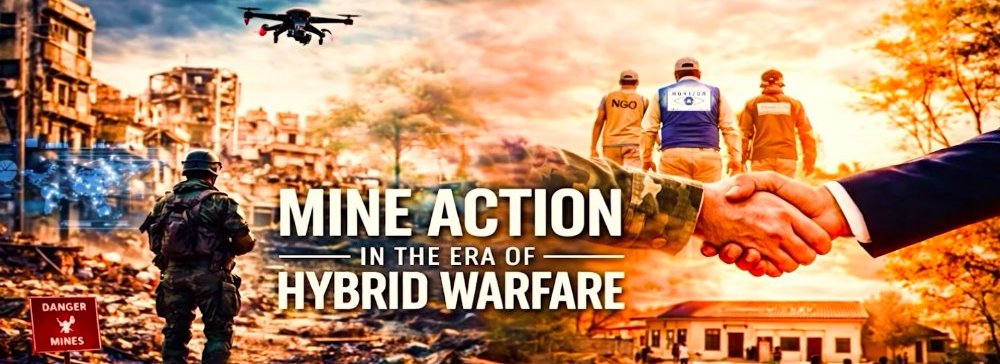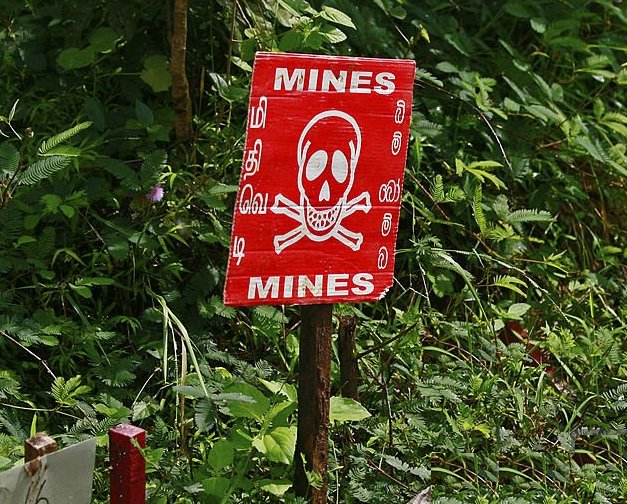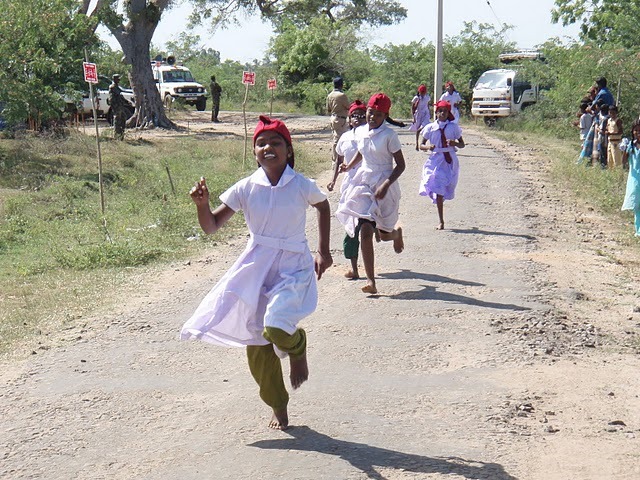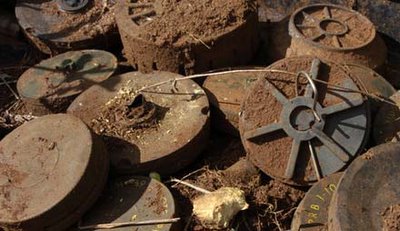
Despite global treaties and decades of humanitarian effort, landmines and explosive remnants of war (ERW) continue to threaten millions. According to the Landmine Monitor, over 4,000 - 6,000 casualties are recorded annually, with civilians representing nearly 80% of victims. Children account for a significant proportion in heavily affected regions.
More than 60 million people worldwide live in contaminated areas. Vast tracts of agricultural land remain unusable. Infrastructure projects stall. Economic recovery slows. Humanitarian access has become restricted. The world is not lacking commitment. It lacks speed, scale, and smarter deployment.
Emerging technologies — Artificial Intelligence (AI), robotics, geospatial analytics, and autonomous systems — offer an opportunity to compress timelines that would otherwise extend decades.
However, technology comes at a cost. The countries most severely affected by war and civil conflict are simultaneously the least able to finance advanced technological ecosystems. This financial paradox requires structured global cooperation.
HSWF, as an international NGO with field execution capacity, advocates for a practical model:
Technology companies innovate. Donors and impact HSWF executes and localizes. Governments regulate and sustain. investors finance. Technology as a Strategic Accelerator
1. Artificial Intelligence in Mine Action
AI transforms fragmented data into predictive insight. Applications include:
• Satellite image analysis to detect disturbed soil
• Conflict-pattern modeling to identify high-probability contamination zones
• Machine learning applied to Ground Penetrating Radar (GPR)
• Automated reporting and clearance validation systems
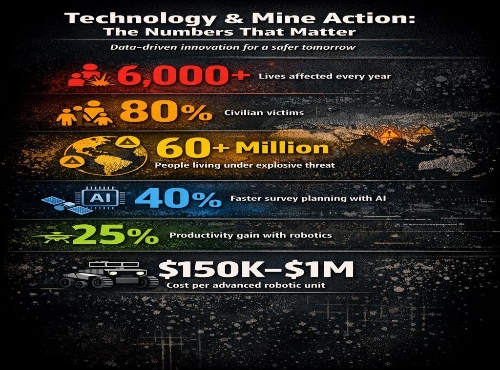
Field pilots coordinated with the United Nations Mine Action Service demonstrate that AI-assisted planning can reduce non-technical survey time by 30–40%
Impact Potential:
• Reduced false positives by up to 50% in selected test environments
• Faster prioritization of high-risk communities
• Improved donor transparency through digital tracking dashboards
AI does not replace deminers — it strengthens their decision-making.
2. Robotics and Autonomous Systems
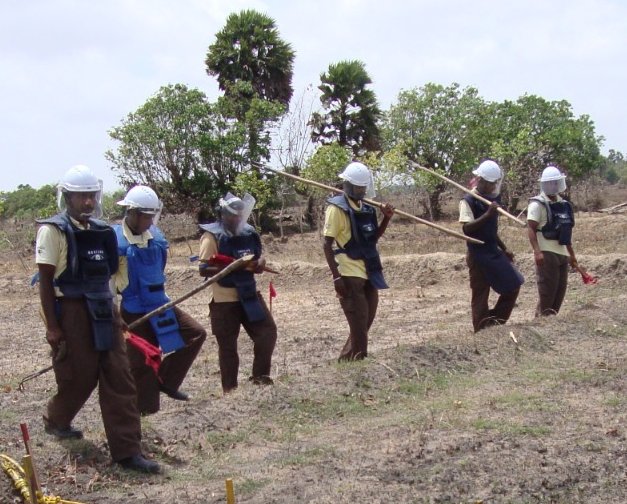
Manual demining remains dangerous. Productivity averages 20–50 square meters per day per deminer, depending on terrain and contamination density.
Robotic integration changes this dynamic:
• Unmanned Ground Vehicles (UGVs) conduct mechanical verification
• Remote flails and tillers prepare suspected land safely
• Drones map several square kilometers daily using multispectral imaging
• Semi-autonomous detection units operate in high-risk zones
Mechanical and robotic solutions have demonstrated productivity gains of 20–25% in suitable terrain categories.
Most importantly:
Every robotic intervention potentially removes a human from direct risk exposure.
The Financial Reality and the Case for Technology Partnership
1. Innovation Is Expensive
Advanced robotics platforms range from USD 150,000 to over USD 1 million per unit. AI infrastructure requires:
• High-performance cloud computing
• Secure data storage
• Cybersecurity integration
• Software licensing
• Continuous technical support
• Specialized training programs
Meanwhile, post-conflict nations face:
• Damaged infrastructure
• Shrinking tax bases
• High reconstruction debt
• Social protection burdens
• Ongoing security expenditures
Expecting them to independently fund advanced AI-robotic ecosystems is neither realistic nor equitable.
2. The Strategic Role of Technology Companies
Global leaders such as Microsoft, Google, IBM, and advanced robotics developers possess infrastructure capable of a transformative humanitarian impact.
Structured engagement may include:
• Cloud computing credits for Mine action data platforms
• AI co-development tailored for humanitarian application
• Open-source algorithm models for predictive mapping
• Robotics leasing models rather than outright capital purchase
• ESG-aligned investment into high-impact clearance programs
• Cybersecurity framework support
This is not philanthropy alone. It is strategic risk reduction and market stabilization. Regions cleared of landmines reopen for:
• Infrastructure projects
• Agricultural production
• Foreign direct investment
• Telecommunications expansion
• Energy and transport corridors
Stability supports global economic integration.
3. Horizon Safer World Foundation (HSWF) as the Execution Bridge
HSWF operates as the implementation backbone in affected regions by:
• Conducting baseline surveys
• Engaging National Mine Action Authorities
• Training and certifying local teams
• Integrating AI mapping tools in field planning
• Deploying robotic platforms responsibly
• Ensuring compliance with International Mine Action Standards (IMAS)
• Delivering transparent reporting to donors and stakeholders
Technology without field execution is theoretical.
Execution without technology is slow. HSWF ensures operational integration.
The Dual Nature of Technology : Boon and Risk
The Boon 1. Increased clearance speed
2. Reduced exposure risk
3. Data transparency and accountability
4. Scalable impact across borders
5. Improved strategic allocation of limited donor resources
In responsible hands, technology compresses decades into years
The Risks
1. Overdependence on automation
2. System failure in extreme environments
3. Maintenance and lifecycle sustainability challenges
4. Digital vulnerability and cyber exposure
5. Widening equity gaps between funded and underfunded nations
Technology must be layered onto strong governance, not substitute it.
Responsible deployment requires:
• Ethical AI frameworks
• Transparent validation protocols
• Hybrid human-machine clearance models
• Long-term maintenance planning
• Local capacity transfer
Data Tables
Global Mine Action Snapshot
| Indicator | Estimated Figures |
| Annual Casualties | ~6,000+ globally |
| Civilians Among Victims | ~80% |
| People Living in Contaminated Areas | ~60 million+ |
| Average Manual Clearance Rate | 20–50 sqm/day/deminer |
| Productivity Increase with Robotics | 20–25% (terrain dependent) |
| AI Planning Efficiency Gain | 30–40% reduction in survey time |
| Robotic Platform Cost Range | $150,000 – $1,000,000+ |
Strategic Policy Recommendations (For Donor and Tech Roundtables)
1. Establish a Global Mine Action Technology Fund
2. Develop public-private AI research consortiums
3. Expand robotics-as-a-service humanitarian models
4. Standardized open data frameworks
5. Embed cybersecurity protocols in Mine Action architecture
6. Mandate capacity transfer to national authorities
Technology can either widen inequality — or reduce it.
It can either sit in innovative labs or clear farmland.
It can either remain commercially concentrated or strategically deployed for humanitarian stability.
The future of mine action will not depend solely on treaties or funding cycles.
It will depend on coordinated innovation.
HSWF stands ready to execute. Technology partners are invited to collaborate.Donors are invited to accelerate scale. A safer tomorrow is not a distant aspiration. It is a coordinated technological decision.